Barnes & Noble
St. Luke was searching to understand Jesus and what he had discovered of Man's connection to God. But I got that from the New Testament. What he got as a clue and wrote into his contributions to the Acts of the Apostles was Jesus recognizing the commonality of all Mankind. While he didn't connect the domains of the whole world, DNA, stars, and minds, this was a majestic foray into the nature of the world, Man, and what God had wrought. It wasn't until the Council of Nicaea in 325 AD that the great mystery of the Holy Ghost and Jesus's place in the Trinity was declared canonical.
As I continue on the more comprehensive volume of Taylor Caldwell's complicated life – Enough Light to See the Darkness: Part II; Seeking a Divine Inspiration – I thought to review (below) the periods of her life from the view of her novels. Note my emphasis on #2, especially Dear and Glorious Physician. That was such a striking change in her career at its midmark that she seemed like a different author after its publication. For one, there was a change in her embedded conspiracy theories in almost all her novels following its publication. In the Part II Biography of Peggy and TC, I emphasize the attempt at a change in Sound of Thunder That sold, but in its attempt to grasp genius it can't hold a candle to Dear and Glorious Physician which had at its heart a true genius, St. Luke. for whom there is considerable documentation.
- Related to the "Dynasty of Death Trilogy" (1938, her first, 1940 1942 1943):
- The "Four Mediterranean Novels" (1959, 1965, 1970, 1974): Dear and Glorious ..., Pillar of Iron (Cicero), Glory and the Lightning (Aspasia and Pericles), Great Lion of God (St. Luke).
- The 5++ Christ in "Your Life Novels" (for example, The Devil's Advocate 1952, Your Sins and Mine 1955, The Listener 1960, Wicked Angel 1965 Answer as a Man 1980 her very last including her own 'autobiography,' "On Growing Up Tough" 1971):
- The Modern World History Novels" (for example, "Time No Longer," "Tender Victory," "Testimony of Two Men," and "Captains and the Kings"):
The #1 list had guard rails: These got her in print and her early audiences. She had to follow the words of certain Publishing house editors. In a personal letter to our family's grandfather, after they weren't quite divorced, she explains that they were the result of a massive first volume that was broken into many volumes. Still, she was clear that her characters' traits were God-given from birth, and their paths were cast by destiny.
The #2 list was a young girlhood fulfillment: These were the novels that came from her early desire to write what became "Dear and Glorious Physician." In terms of originality, this was the best of these and certainly the most popular—also, the hardest to explain. None of the seven long novels of Mary Anne Evans (George Eliot) capture her desire to fathom what brought Jesus his followers. Yet, she tells of how she was taken with the subject. "Dear and Glorious ..." is TC's version of that goal. Of all TC's novels, this deserves the most attention. The Part II Afterword will give it.
She engaged these two topics in her novels, though she left puzzling conclusions as if her only goal was finishing another novel.
Paul and Luke, neither of them apostles, were the earliest in print to manage a sense of what drove Jesus. How humans deal with Jesus' place in their needs for energy and money that dominates their lives. Though one of these is particular, the other is general. They lay out TC's attempt to say what life is about. Her personal life, however, gave a different picture.
The list of #3 was more automatic: Much of it was vignette storytelling intended to satirize liberals. Much of it came near the end of her life, castigating those who failed to follow her 'pray-mindlessly mantra.' Modern evangelicals can easily stand with these novels and against the forces of modernity. Those who seriously treasure Jesus, St. Paul and St. Luke in their own words, not so much. Yet, here you have what still commands an audience today.
Conspiracy theories became her favorite approach – evil enemies who didn't think like her. So, she took to the John Birch Society and they to her. She and Robert Welch made quite a pair; he the intellectual, and she the emotive popularizer of the conservative mentality.
If you only knew of the novels of #4, you might not have recognized her exceptional conservativeness. Two produced television series. Having learned how TV and movie productions work, I see why it was valuable to have TC's originals on which to base them and why TC's predilections didn't have to dominate.
Since TC wrote 40+ novels, and her career was essentially done after (apparently, still replete with mysteries) a debilitating stroke in 1979, the novels that fit #4 were the cement between her writing periods. Not just a cement but also a leavening that meant she was not so easily typecast as exceptional cases of her novels would indicate. Of course, you can't justify a writing career on breadth if you want credit for any depth. Depth was not TC's forte. Still, here she is relevant today based on what she covered and insistence on the place of the conservative view (repeated by central Republicans today), which she did so vehemently much to formulate, promulgate, and encourage.
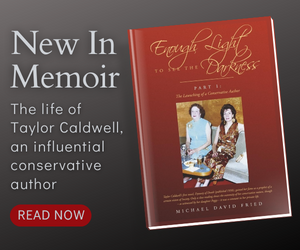
Go here for Amazon Sales:
For the Descendants of Taylor Caldwell |