The body of Enough Light to See the Darkness:
Part II: Seeking a Divine Inspiration
should be done by the end of August, with the concluding Afterword chapter, and media files, etc. done in September.

This newsletter starts with an Openroad special sale of two TC books that wrap her career and still feature the best of her writings outside her themes that I have previously developed around Christianity and Dear and Glorious Physician. It is followed by a synopsis of what I think captures TC's relevance today that takes Part II of the intense, entwined relationship of TC and her daughter Peggy to a fitting conclusion at the end of her writing career. Then, when she has been captured in a relationship with a sinister character, Robert Prestie

Here is the advertisement for the sale of

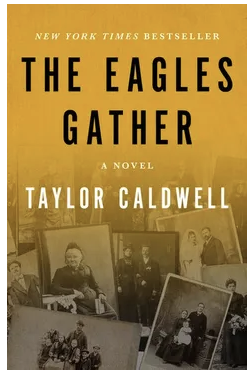
The Eagles Gather By Taylor Caldwell (1940)
one of the four novels that heralded TC's career and conspiracy prognostications that started with Dynasty of Death
$2.99 normally $17.99 Expires 8/15/24. In the decade after World War I, Jules Bouchard prepares to leave his son Armand, who has a controlling interest in his global munitions enterprise. But the inheritance comes with a warning: Armand’s ruthless brothers, Emile and Christopher, will be gunning for him, and the ensuing treachery threatens to tear the family apart (The New York Times Book Review).


Amazon
Barnes and Noble

Here is the advertisement for the sale of

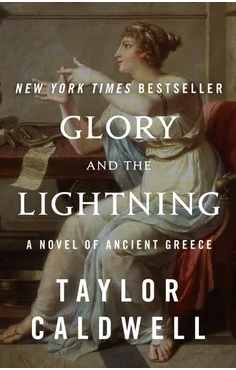
Glory and the Lightning By Taylor Caldwell (1974)
one of the four novels that I refer to as her Mediterranean novels, and without question centered on one of the greatest love stories of all time, that between Pericles, the peerless leader of Athens during its spectacular rise as the quintessential model for Democracy, and the gorgeous and brilliant Aspasia.
$2.99 normally $17.99 Expires 8/15/24. There were five previous attempts to capture this magnificent couple to that of TC's. This is certainly different from those others. It captures why history can't forget these two, though it is not complete on the pathos that so hurt Pericles that Athens couldn't accept Aspasia. Generally, I like Openroad's covers, though I'm less satisfied with this one, as it fails to capture what was so captivating about Aspasia in her day.
Amazon
Barnes and Noble

Sometime in the late '70s, there was a common refrain that looking back at Jim Crow was ridiculous: so long ago, not relevant today, and, anyway, misunderstood as being much worse than it was. Thinking people know, for sure, that was ridiculous on all fronts, but it certainly was compatible with TC's thinking.

Later, a different set of phrases covered the Nazi era: Germany has attoned entirely for that, people there no longer have any of those predilections, and, anyway, it wasn't as bad as people think. I visited Germany several times from 1975 to 1996, including two years on a famous (Alexander von Humboldt, lucrative) fellowship that made my most important project possible because it gave me a place to lecture on the pieces as they developed. Also, time away from teaching. (It wasn't my only big fellowship, but it was an auspicious time for developing this challenging project.) By accident, I kept on finding myself – because I got lost in my little explorations, and my German was new and not fluent – in what were, clearly, neonazi gatherings.

The resurrection of Hitler's thoughts by Trump and his followers is part of what joins them, still today with TC. Of course, in my – and Peggy's – telling, TC is a sad-sack. Yet, so are Trump and JD Vance. Also, that's what they thought of Hitler way back when, as he built up his brown shirts and SS troopers. It is good to see solid thinking on the nature of Hitler's different types of enablers today that join with thoughts on conspiracy theorists and Trump followers.

That is, those who thought you could forget about some awful pieces of history – because people aren't like that anymore? – are not seeing what is right in front of them when the floodgates to the strangest parts of the human mind are opened by cynical, selfish, evil, and conniving, or confused and fearful people. Those are three different kinds of people.

TC primarily sought her villains among those she claimed enabled WWI, communists and socialists, abstractly piggybacking on the conspiracy theories of the likes of Father Coughlin. This calls for considerable comment, which will appear in the Part II Afterword.

Only after the period of DAG and her 'new' religious concentration on Jesus did her conspiracy-mongering concentrate on people from WWII. Especially FDR and the acts of his (first female) cabinet member Francis Perkins, who gave us Social Security, progressive income taxes, and subsidized health care. These are services provided to average Americans that TC and other conservatives abhor to this day. They use them but can't abide that people they don't like get them. TC though was rich, and her hatred of the services was primarily because they meant she paid income taxes to America. She was as anti-feminist as Phyllis Schlafly, who came along later.

The Part II Afterword

Part II with its core Peggy's autobiography, ends with TC married to Robert Prestie but starting to have severe medical problems as she finishes her final two publications: Bright Flows the River (1978) and Answer as a Man (1980). Neither has much literary value nor imaginative reimagining of her themes, but they do – as much as any of her previous writings – give an edge to her most extreme predilections. Here, she assumes that most Americans share her extreme conservative values. No wonder she hated the '70s. Yet, Peggy has no idea of what the world at large thinks of TC.

The first half of Part III (despite a first text draft, as Part II will take some time to appear, this will take considerable further time) is Peggy's battle with Robert Prestie, TC's last husband. He managed (and it's still a mystery how) to wrest TC from Peggy's watchful eye and to command her money into his own accounts. The even greater mystery: How did Prestie finagle to hide TC's physical state from the authorities. Her last novel, Answer as a Man, appeared five years before her official death in 1985.

The Afterword is based on my journal entries, a version of what Peggy did, to discuss the deaths of TC, Peggy's sister Judy (by suicide) and then my parents, Peggy and Gerry. My addendum is how much I learned about Dying in America. That may not be directly useful when my time comes.


Go here for Part I: Amazon Sales:
There have been several reorders of the original stock.

The sign-up for the Enough Light Newsletter is here.
Michael Fried, Grandson
For the Descendants of Taylor Caldwell