Project: 1-D Finite Difference Method
The purpose of this project is to introduce the finite difference. We use 1-D Poisson equation in (0,1) with Dirichlet boundary condition

Contents
Step 1: Generate a grid
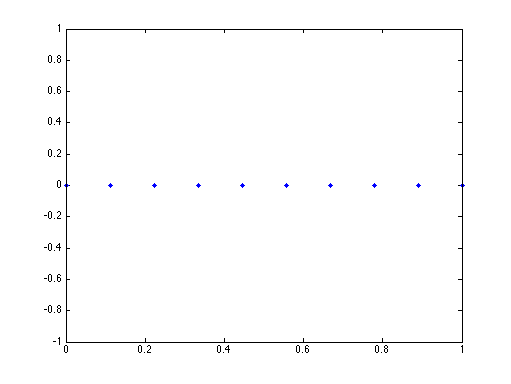
Generate a vector representing a uniform grid with size h of (0,1).
N = 10;
x = linspace(0,1,N);
plot(x,0,'b.','Markersize',16)
Step 2: Generate a matrix equation
Based on the grid, the function  is discretized by a vector u. The derivative
  are approximated by centeral finite difference:


The equation  is discretized at
  as
as

where  . These linear equations can be written as a matrix equation A*u = f, where A is a tri-diagonal matrix (-1,2,-1)/h^2.
n = 5;
e = ones(n,1);
A = spdiags([e -2*e e], -1:1, n, n);
display(full(A));
ans =

    -2     1     0     0     0
     1    -2     1     0     0
     0     1    -2     1     0
     0     0     1    -2     1
     0     0     0     1    -2
We use spdiags to speed up the generation of the matrix. If using diag, ....
Stpe 3: Modify the matrix and right hand side to impose boundary condition
The discretization fails at boundary vertices since no nodes outside the interval. Howevery the boundary value is given by the problem: u(1) = a, u(N) = b.
These two equations can be included in the matrix by changing A(1,:) = [1, 0 ..., 0] and A(:,N) = [0, 0, ..., 1] and |f(1) = a/h^2, f(N) = b/h^2.
A(1,1) = 1;
A(1,2) = 0;
A(n,n) = 1;
A(n,n-1) = 0;
display(full(A));
ans =

     1     0     0     0     0
     1    -2     1     0     0
     0     1    -2     1     0
     0     0     1    -2     1
     0     0     0     0     1
Step 4: Test of code
[u,x] = poisson1D(0,1,5);
plot(x,sin(x),x,u,'r*');
legend('exact solution','approximate solution')
Undefined function 'poisson1D' for input arguments of type 'double'.

Error in projectFDM1D (line 54)
[u,x] = poisson1D(0,1,5);
We test ... The result seems correct since the computed solution fits well on the curve of the true solution.
Step 5: Check the Convergence Rate
err = zeros(4,1);
h = zeros(4,1);
for k = 1:4
    [u,x] = poisson1D(0,1,2^k+1);
    uI = sin(x);
    err(k) = max(abs(u-uI));
    h(k) = 1/2^k;
end
display(err)
loglog(h,err,h,h.^2);
legend('error','h^2');
axis tight;
Since these two lines have the same lope, the err decays like h^2.