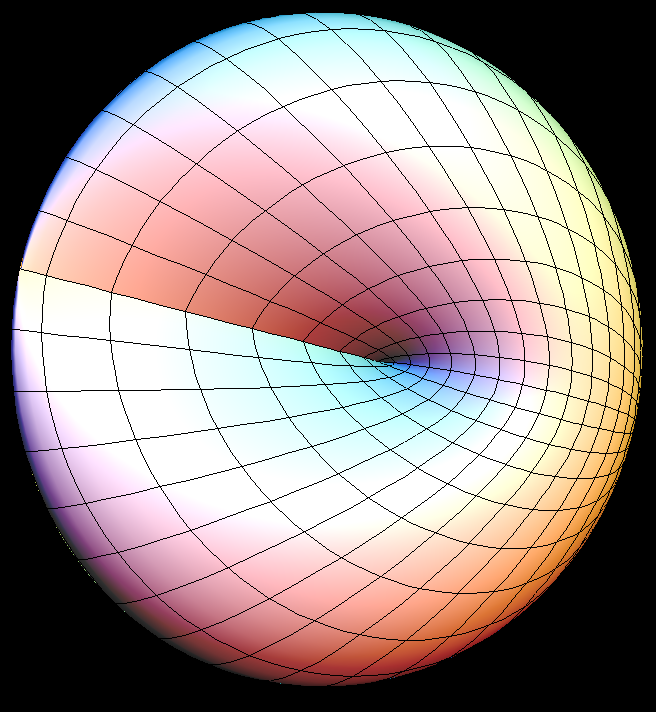
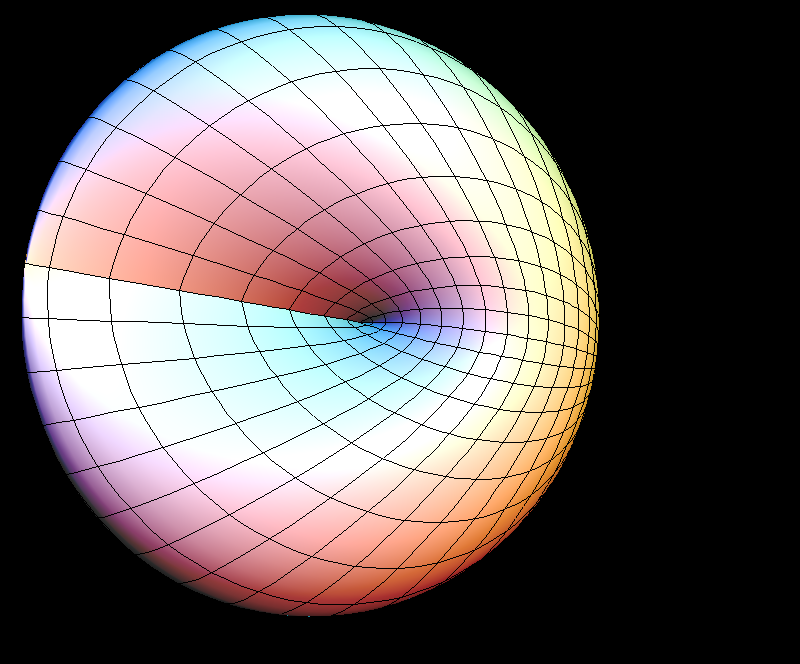
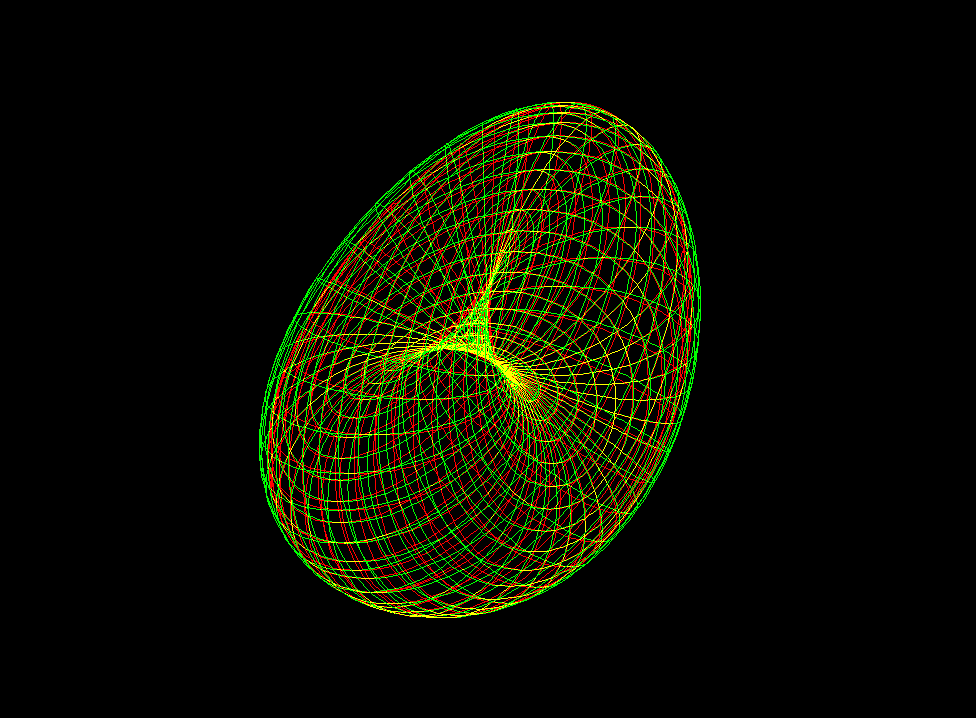
If x(u,v), y(u,v), z(u,v) is a parametrization of the sphere, then (xy,yz,zx)(u,v) has the same value
at antipodal points P and -P and therefore gives an image of the projective plane, called cross-cap.
The cross-cap is the first discovery of an image of the projective plane in R^3. It is a surface with
a selfintersection segment and at the endpoints of this segment the surface has socalled pinch point singularities.
The first image of the projective plane with no singularities (but of course with selfintersections) is Boy's surface.
This parametrization of the sphere:
 (sin(u)*cos(v), sin(u)*sin(v), cos(u))
gives the following cross-cap parametrization:
  x = aa * sin(u) * sin(u) * sin(2*v)/2
  y = aa * sin(2*u) * sin(v) / 2
  z = aa * sin(2*u) * cos(v) / 2
where aa is a constant.
The cross-cap was the first surface that represented the projective plane in R^3.
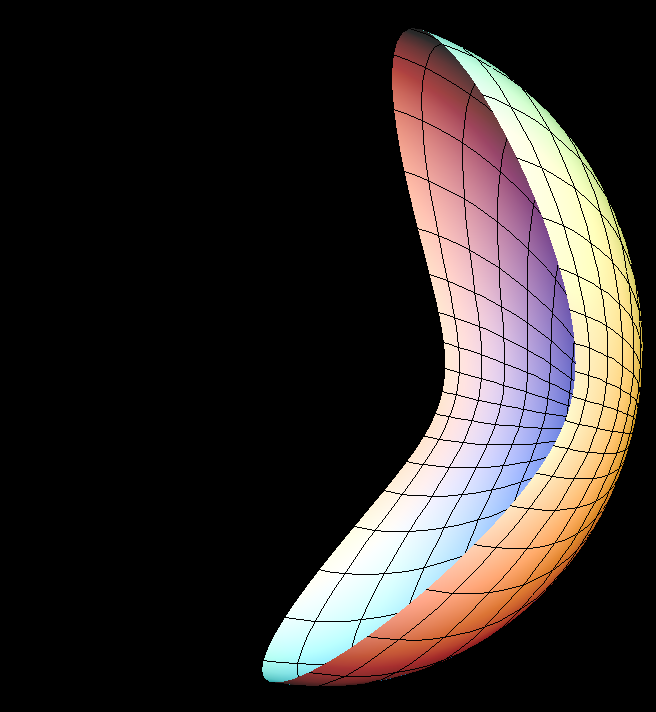
Imagine a half-sphere and connect the opposite points on its boundary. the animation
shows one way to do this in R^3.
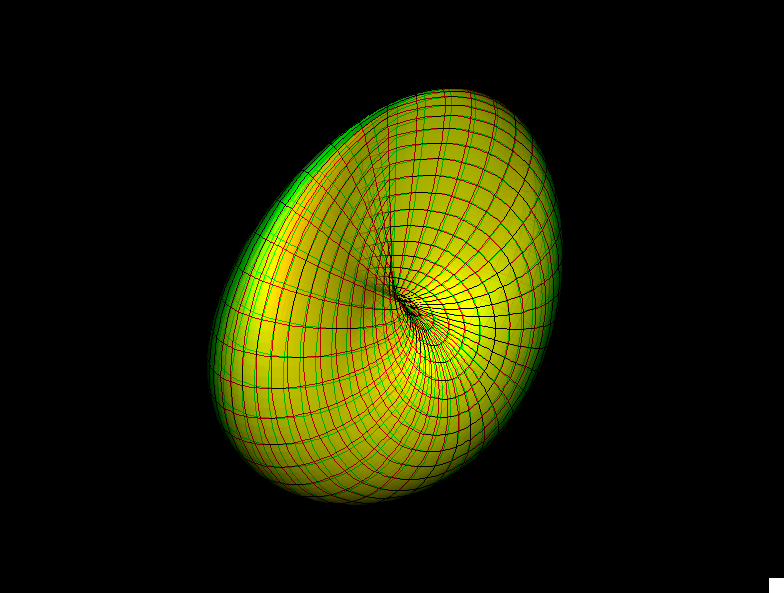
The cross-cap is made of a 1-parameter family of circles. The strip between
two neighboring circles is a Moebius strip. The animation moves these
Moebius strips over the surface.
The cross-caps occur as a natural family, the ratio between the largest and smallest circle
of the cap parametrizes the family. For a surface of positive curvature one has at points where
the principal curvatures are not the same a natural cross-cap made out of the normal curvature
circles at the chosen point.
Cross-Cap Surface Anaglyph.
Last steps before the boundary is closed along a self-intersection.
cross cap st
cross cap sw