
We perform fundamental studies of the behavior of two or more fluids
subject to external and internal forces. We are particularly interested
in the effect of surface tension on the flow morphology.
A. Phase-field models. We have been developing new physically based models capable of
simulating flows with two or more components with varying miscibilities.
A new system of equations, the Navier-Stokes-Cahn-Hilliard System, has
been derived. In this approach, related to phase-field models more
traditionally used in phase-transformations, sharp interfaces are replaced
by narrow transition regions. Concentration fields and corresponding
Helmholtz free energies are introduced that characterize the miscibility
properties of the components. The concentration fields satisfy a fourth
order nonlinear advection-diffusion equation (Cahn-Hilliard) and are
coupled to the Navier-Stokes equations through extra reactive stresses
that mimic surface tension. Examples of such flows are shown below.
B. Models of surfactants. We have been developing new physically based models
of interfacial flows with surfactants. The key here is to develop an Eulerian approach
that can be used together with numerical methods such as the volume-of-fluid or level-set
method. The reason for using these methods is that they are capable of capturing topology
transitions such as drop-breakup and coalescence. The presence of
surfactants has a profound effect on these processes.
Our approach follows two directions:
(1). The development of new,
physically-motivated and experimentally validated multiphase flow models;
(2). The development of
state-of-the-art adaptive numerical methods;
(1). New physically motivated multiphase flow models
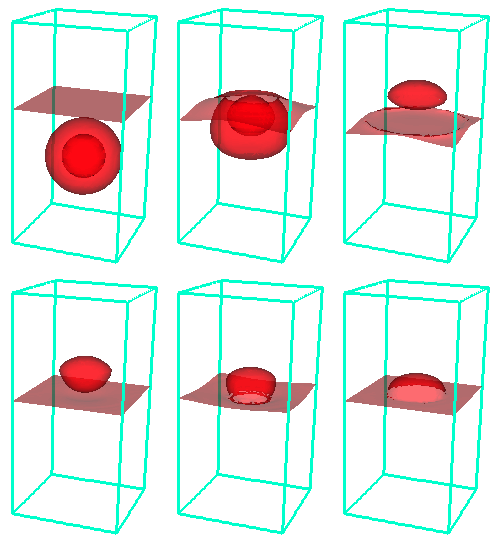
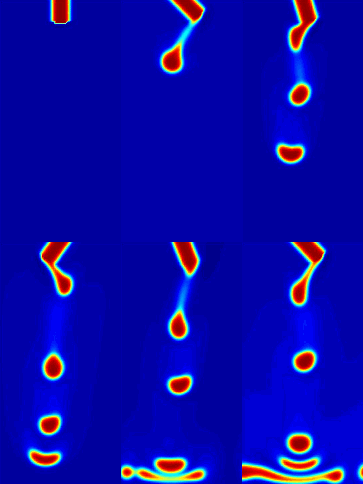
A derivation of the two-phase model can be found in
J.S. Lowengrub and L. Truskinovsky,
Quasi-incompressible Cahn-Hilliard Fluids and
Topological Transitions,
Proc. Roy. Soc. London A 454 (1998) 2617-2654.
The three-phase model can be found in
(J.S. Kim and J.S. Lowengrub,
Ternary Cahn-Hilliard fluids,
with J.-S. Kim, Int. Free Bound. in review).
The models are nontrivial to solve as they couple a nonlinear
fourth order advection-diffusion equation (Cahn-Hilliard) with
the Navier-Stokes equations. To solve the coupled system, we have
developed very efficient nonlinear multigrid methods. See for
example
Conservative multigrid methods for Cahn-Hilliard fluids}, with J.-S. Kim,
K. Kang, J. Comp. Phys. 193 (2004) 511-543.
We are currently developing adaptive nonlinear multigrid methods
for this problem (see below).
Collaborators:
Jun-Seok Kim Ph.D. (2002,UMN)
Together with
Professor Ashley James we have developed a
A surfactant conserving volume-of-fluid method for interfacial flows with
insoluble surfactant, J. Comp. Phys. 201 (2004) 685-722.
(2). State-of-the-art adaptive numerical methods
A. Unstructured mesh refinement.
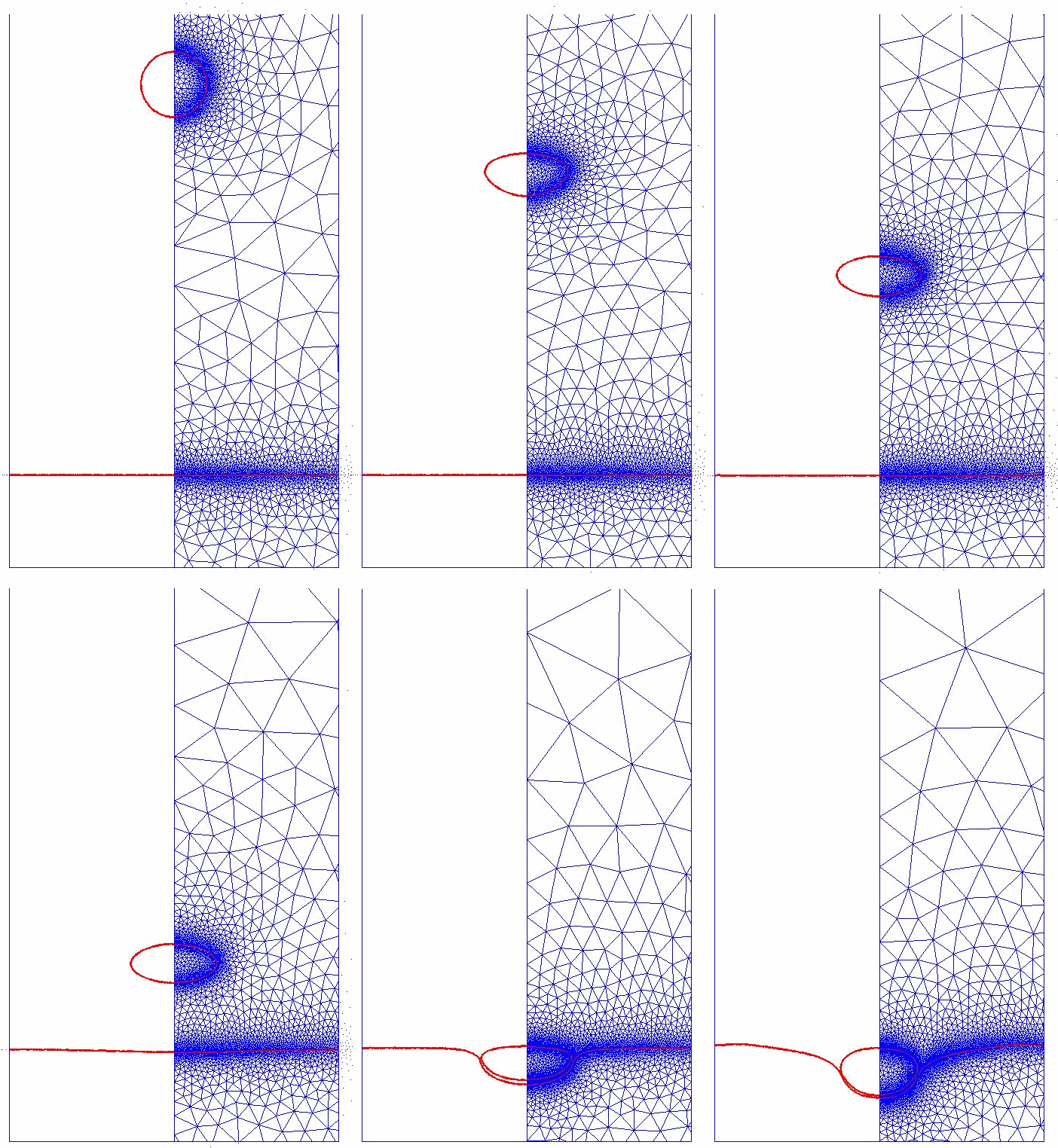
Very recently, we have developed an adaptive remeshing algorithm for meshes of unstructured
triangles in two dimensions and unstructured tetrahedra in three
dimensions. The algorithm automatically adjusts the size of the elements
with time and position in the computational domain in order
to resolve the relevant scales in multiscale physical systems to a
user-prescribed accuracy while minimizing computational cost. The
optimal mesh that provides the desired resolution is achieved by minimizing
a spring-like mesh energy function that depends on the local
physical scales using local mesh restructuring operations that include
edge-swapping, element insertion/removal, and dynamic mesh-node
displacement (equilibration). The algorithm is a generalization to volume
domains of the adaptive surface remeshing algorithm developed
by
Cristini et al., J. Comp. Phys. 168 (2001) 445-463.
in the context of deforming interfaces in two and
three dimensions.
The algorithm is versatile and can be applied to a number
of physical and biological problems, where the local length scales
are dictated by the specific problem.
The reference for this work is (
X. Zheng, A. Anderson, J.S. Lowengrub and V. Cristini,
Adaptive unstructured volume remeshing algorithms: Application
to level-set simulations of multiphase flows,
J. Comp. Phys. in review).
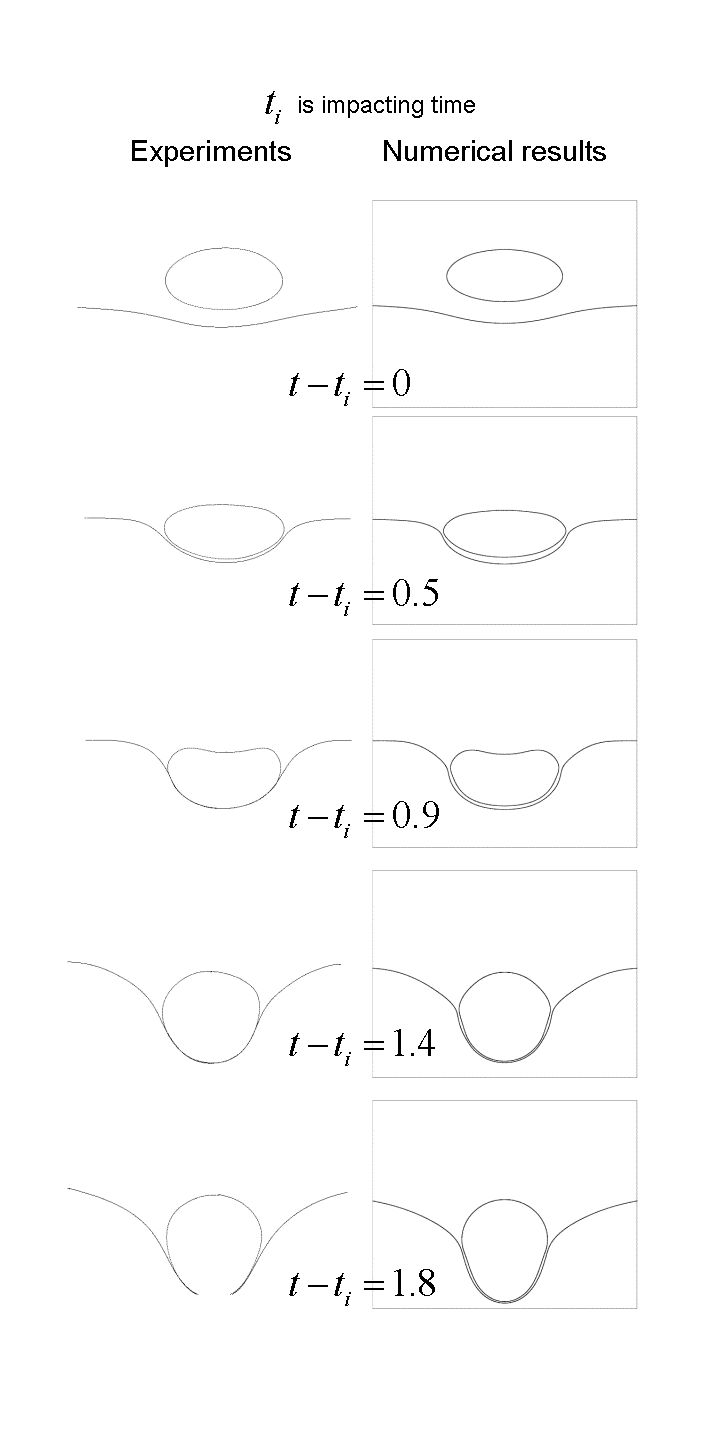
An example of this approach is shown below.
Comparisons with
by
recent experiments by Dr. Z. Mohamed-Kassim and Professor Ellen Longmire are shown.
Collaborators:
Xiaoming Zheng (Ph.D. 2005,UCI. Current: U. Michigan) ,
Tony Anderson (Ph.D. 2008, Northwestern U. (Applied Math Dept), expected),
Professor Vittorio Cristini .
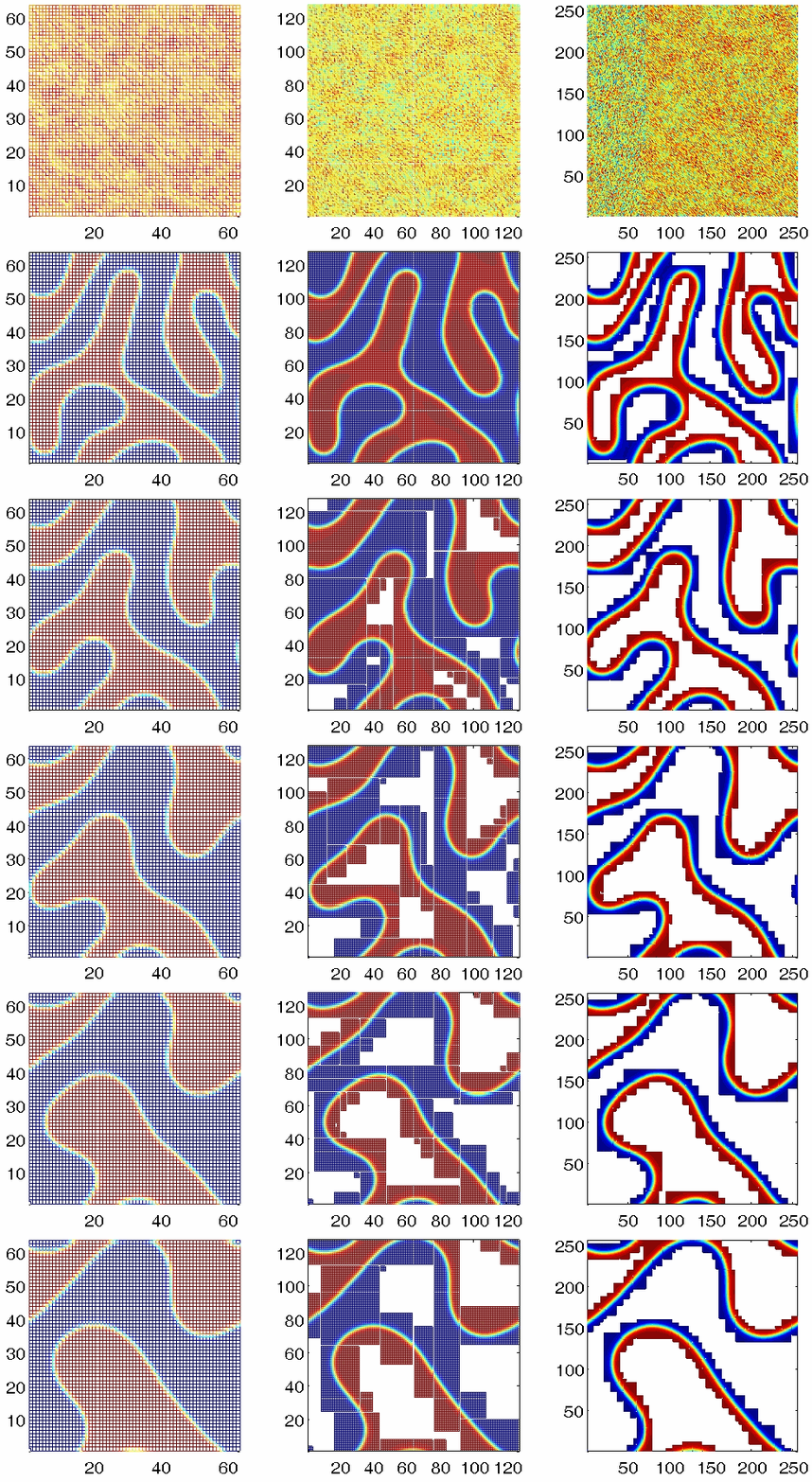
B. Structured mesh refinement.
We have recently been developing adaptive numerical algorithms
using block-structured Cartesian mesh refinement. In this approach, overlapping
finite difference Cartesian meshes involving different grid sizes is used to achieve local
refinement. We are particularly interested in refining sharp transition regions in the phase-field models.
An example is given below.
Nonlinear multigrid method using adaptive overlapping Cartesian meshes.
Left: Coarse mesh; Middle: Refined mesh; Right: Finest mesh.
Collaborators:
Jun-Seok Kim Ph.D. (2002,UMN) , and
Steven Wise Ph.D.
.